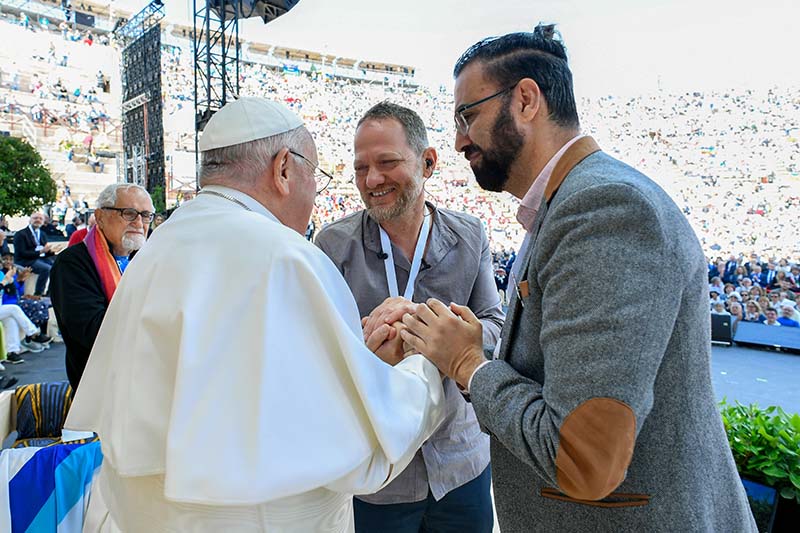
JERUSALEM— The last time peace activist and social entrepreneur Maoz Inon spoke to his father was at 7:30 a.m. on Oct. 7, 2023, after he posted on the family chat about missiles falling and sounds of war all around them in Netiv Ha’asara, the Israeli farming community closest to the Gaza border.
They spoke briefly, his father assuring him that he and his mother had locked their house and were in their safe room. Inon, making morning coffee for his wife in their home in the pastoral northern town of Binyamina, told his parents he loved them and would call soon. With Netiv Ha’asara just 109 yards from Gaza, Inon thought it was just another episode in the long-running violence along the border.
Horror set in as Inon saw terrifying images on social media of Hamas terrorists attacking Israeli border communities. By 7:40 a.m. when he called his parents again there was no answer. He and his three sisters gathered in the home of one of his sisters as his youngest brother made his way to Israel from London, and in the late afternoon they reached the community’s security officer who told them their parent’s house had been burned to ashes and two bodies were found inside.
Joint statement rejecting revenge
The siblings began the traditional Jewish mourning period, known as shiva, and already on the second day, at the urging of his brother Magen, they issued a joint statement rejecting revenge in the name of their parents. They also were among the first Israelis to speak out about the deaths of civilians in Gaza.
“Revenge is not going to bring them back and will only escalate the cycle we’ve been trapped within for more than a century — the Israeli and Palestinian cycle of bloodshed, revenge and death. (My brother) wanted us to find a path to save us from this cycle,” said Inon, 50, sitting in the patio of his home just before the second anniversary of the Hamas massacre and murder of his parents, Bilha and Yakov Inon. They were among the 1,200 people killed by Hamas that day. Some 250 people were kidnapped, and 48 are still captive in Gaza with 20 or 22 still believed to be alive.
For Inon, the past two years have been a personal journey from profound loss and anger toward the Israeli government to embracing “radical forgiveness” and working for lasting Israeli-Palestinian peace through InterAct — the NGO he co-founded with Palestinian partners Aziz Abu Sarah and Hamze Awawde.
Israeli-Palestinian dialogue
Abu Sarah’s brother died after being beaten in an Israeli jail during the first intifada, while Awawde is dedicated to dialogue for peace. Inon’s earlier work in Israeli-Palestinian dialogue, including his 2005 Fauzi Azar Inn guest house venture in Nazareth, laid the foundation for his current efforts.
All of Inon’s siblings have also shifted their careers to become peace and reconciliation builders, with one sister chairing the Israeli-Palestinian Bereaved Families for Peace Forum.
Inon described how for three days after his parents’ murder he was overwhelmed by “pain and sorrow,” feeling broken.
One night, as he cried through his sleep, he had a “vision” of all humanity crying with him, their tears healing wounds, purifying blood-soaked land and revealing a path to peace. When he woke, he knew this was the path to honor his parents’ legacy.
‘In order to heal myself’
“I choose to walk this path in order to heal myself,” he told OSV News. “There are three lessons that I learned since October 7th. The lessons of hope, the lesson of the future, and the lesson of forgiveness. Of course forgiveness is the most difficult one.”
Yet inspired by Awawde and Abu Sarah, who chose forgiveness over the “slavery” of vengeance, Inon forgave Hamas, seeing their actions as aligned with their charter to destroy Israel. Forgiving the Israeli government was harder, as he blamed them for his parents’ deaths because of broken promises of security. However, he realized holding onto anger was damaging, and that forgiveness was about healing, not absolution.
Hope, he said, is an action.
Working with others to create actions
“It’s a series of actions that you create by working with others, envisioning a better future and acting in order to make it into reality,” he said. “This is how in time of despair, time of devastation, time of pain, you rise. You’re creating hope. There are so many individuals and organizations nowadays and for the last 20 years that rise up and create hope on a daily basis, Israelis and Palestinians.”
The future, he said, is where Israelis and Palestinians meet.
A few months into the war, Inon joined 70 Israeli and Palestinian peace activists in Geneva, sponsored by the Principles for Peace Foundation, to discuss common ground for the future.
Read more: https://www.osvnews.com/after-oct-7-attack-jewish-man-who-chose-forgiveness-over-revenge-works-for-peace/
By Judith Sudilovsky | osvnews