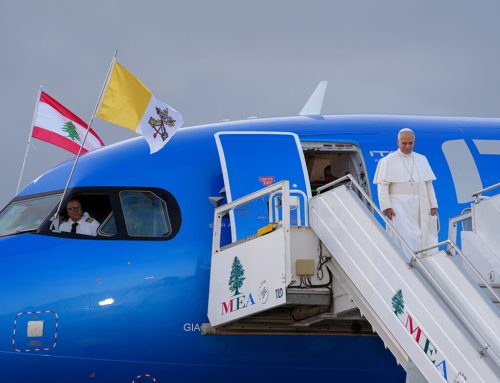
Pope Leo XIV will visit Lebanon from November 30 to December 2, a balm for a country that has struggled for years with political and economic stagnation and that resists despair, despite the devastation caused by Israeli bombardments in the recent war against Hezbollah. We recount this in this brief reportage from Lebanon.
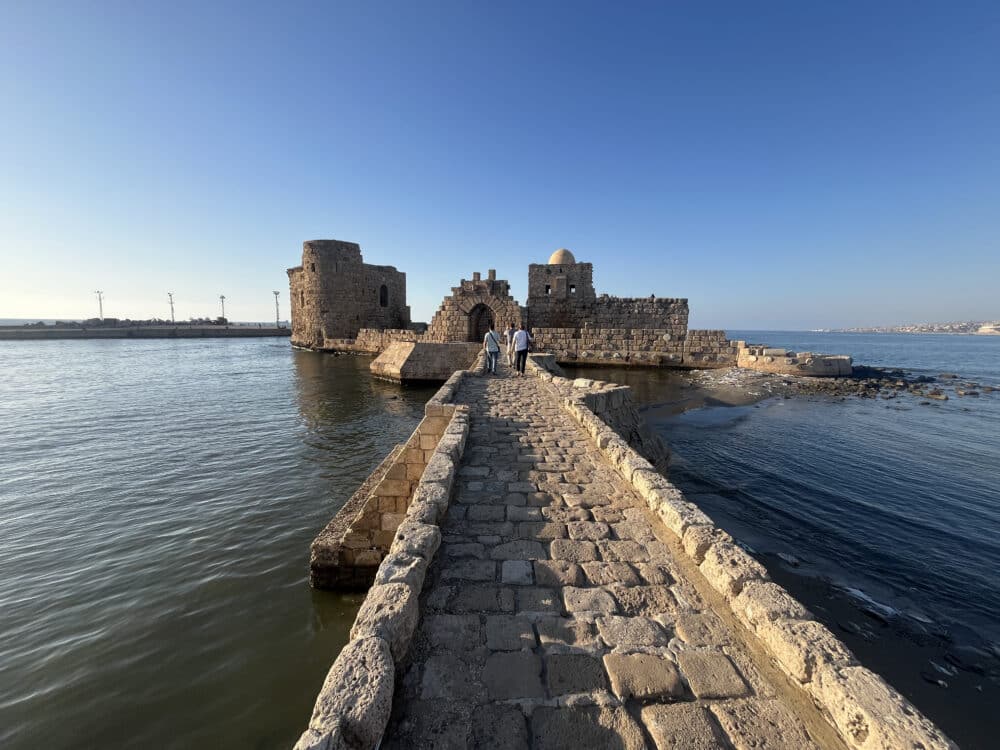
The waters of the Eastern Mediterranean lap against the stones of the Crusader citadel of Sidon, which rests imposingly at sunset, as it has for almost a thousand years. Around the citadel, about ten kilometers further south and on the surrounding mountains, hundreds of more recent buildings have not been so lucky and lie in ruins.

From the villages of the South to the suburbs of Sidon, entire blocks were wiped out in the war between Israel and Hezbollah, which between July and November 2024 caused at least 5,000 deaths and forced 1.5 million people to flee. Some have returned after the truce, despite the high tension and the fact that heavy bombardments often still occur near the border.
Few have never left and can tell what happened here. Like Haziz, who stayed to watch over his family homes and olive trees while his wife and children sought refuge with relatives in Beirut. “At that time,” Haziz recalls, “it felt like there was always an earthquake, bombs fell day and night, and the ground shook constantly.”
We are in Sarba, a Christian village of 3,000 souls, in the mountains above Sidon. Isolated during the bombings, today the village is coming back to life also thanks to the Sarba Cultural House, which carries out a very special activity. “Here,” Mona, the center’s director, explains to us, “we have been teaching Italian for some years now, and many children practically speak it. In the years before the war, we also prepared theatrical performances, performing Dante and Pirandello!”
The unusual activity was promoted by Mona, who teaches Italian at the university in Beirut. Given that there were few extracurricular activities in the village, she decided to start these courses in three spare rooms under her house. “And Italian is useful,” Mona continues, “for when we finally start having tourists again.”
In the past four years, the center has adapted to the needs caused by the crisis and now also provides school catch-up courses for the whole village, because lessons take place only four days a week due to terrible inflation: “transport costs are still too high, and we had to reduce hours because teachers and students could not afford to attend lessons every day!” Pro Terra Sancta plans to support school courses in Sarba and other small initiatives, including the opening of a medical dispensary.
But the surprises don’t end here: while visiting the village, we are led to a field where, at one point, we discover an entrance to a small cave. “Here,” the mayor of Sarba tells us, “one day a farmer was digging to plant a fruit tree and discovered this cave, which apparently contains a complex of tombs, possibly Roman.”
Inside, in addition to the tombs, there are also ancient bone remains. Pro Terra Sancta is evaluating supporting an intervention to recover and preserve the archaeological, cultural, and natural heritage, as it already does in northern Lebanon: in the Tripoli area, the association, in collaboration with various partners, carries out a natural heritage recovery project promoted by the Italian Agency for Cooperation (AICS).

In addition to the cultural and natural heritage recovery project that began this summer, in Tripoli extracurricular proposals for music and sports continue, as well as activities of the medical dispensary, which, in addition to distributing medicines that are hard to find elsewhere, is able to provide at least 15,000 visits per year.
In Beirut, the last stop of our visit, the distribution of medicines continues to be a fundamental element, and here too Pro Terra Sancta has set up a medical dispensary where it is expected to guarantee at least 12,000 visits per year. “This dispensary,” Bashar tells us, “is a guarantee because here I know I can find medicines that I cannot get elsewhere in Beirut or because I could not afford even an aspirin with my four jobs given the prices.”
The distribution of medicines is not completely free: “We ask people,” explains Stephanie, the pharmacist, “to pay a small percentage of the medicines they purchase. Even a minimal percentage is important to avoid falling into charity dependency and to encourage project sustainability. In reality, people often feel better paying something because asking for help can be humiliating.”
Read more: https://www.proterrasancta.org/en/news/in-southern-lebanon-between-the-rubble-and-the-sea
By proterrasancta