A detailed field report by the Syriac Strategic Research Centre (SSRC) has documented what it calls a “pattern of escalating violations” against Syria’s Christian population since the fall of the authoritarian regime of Bashar al-Assad in December 2024. The report, Protecting Syria’s Religious and Ethnic Minorities: The Need for Urgent Action, was released at the end of October 2025 and records more than a dozen major incidents of violence, desecration, and systemic discrimination across the country.
According to the SSRC, the political upheaval that followed the regime’s collapse left large parts of Syria fragmented among armed factions, creating a power vacuum that emboldened extremist groups and allowed sectarian violence to spread. The report describes a “climate of fear and impunity” in which attacks on churches, cemeteries, and Christian homes have become frequent, and where education and security institutions have begun to adopt discriminatory policies.
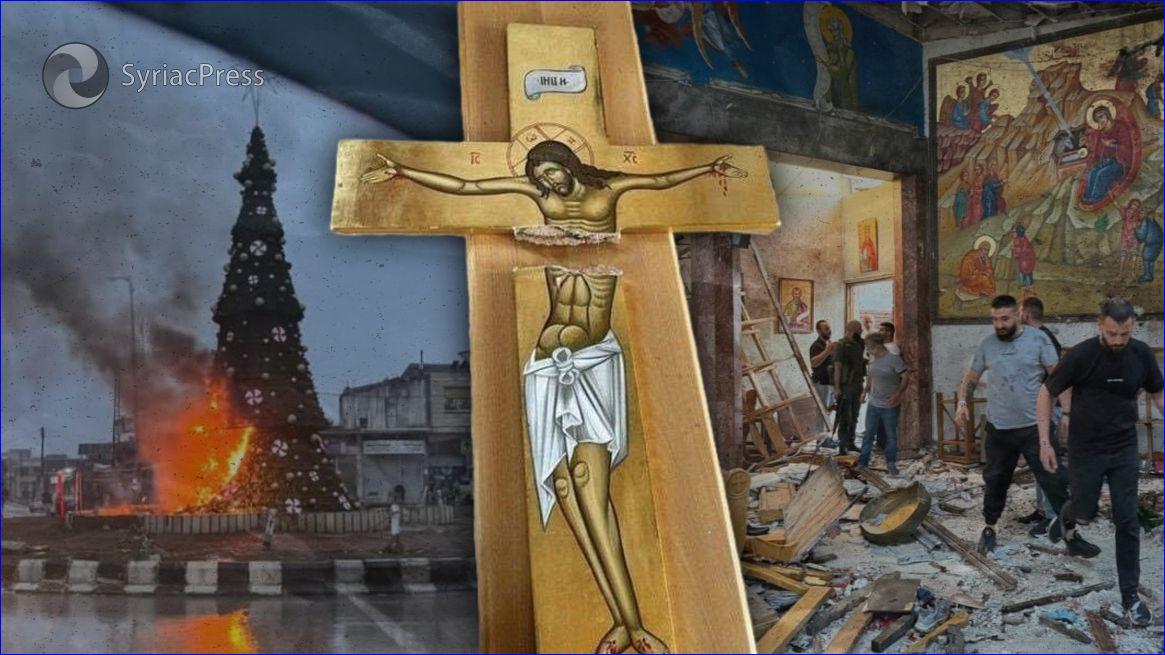
According to the report, churches and cemeteries have been repeatedly vandalized, crosses destroyed, and Christmas trees set on fire in several cities. The SSRC noted that in December 2024, gunmen attacked the Greek (Rûm) Orthodox Archdiocese in Hemto (Hama), desecrated a cemetery, and destroyed religious icons. Around the same time, armed groups entered Christian districts of Holeb (Aleppo), forcing residents to comply with religious dress codes and segregate men and women in public spaces. Videos of militants burning crosses and denouncing Christians were widely shared on social media.
The report also documented the suicide bombing targeting the Mar Elias Church in Daramsuq (Damascus) on 22 June 2025, which claimed the lives of 29 worshippers and wounded 60 others. The attack, attributed by the government to the Islamic State (ISIS), is described as “a devastating blow to one of the few remaining active Christian congregations in the capital.” Additional incidents include assassinations along the Latakia highway, kidnappings in Hmoth (Homs) province, and a series of arson attacks that forced families to flee from long-established Christian neighborhoods.
While the perpetrators often remain unidentified, the SRRC says evidence points to a mix of jihadist cells, opportunistic militias, and local authorities. Some groups, such as Hayat Tahrir al-Sham (HTS), now the de facto government of Syria, reportedly issued apologies or paid compensation after incidents, but the absence of transparent investigations or judicial accountability has left survivors without justice. “Impunity has become the rule, not the exception,” the report states.
Beyond physical violence, the report highlights administrative and cultural pressures. It notes sweeping education reforms introduced in January 2025 that, according to community leaders, infuse religious language into public school curricula and marginalize Christian history and culture. Local Church figures interviewed by the SSRC said the new textbooks “risk institutionalizing discrimination and eroding the pluralistic identity of Syria.”
Read more: http://www.aina.org/news/20251108140017.htm
By Syriac Press