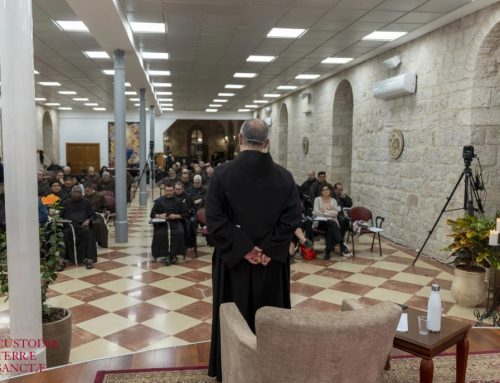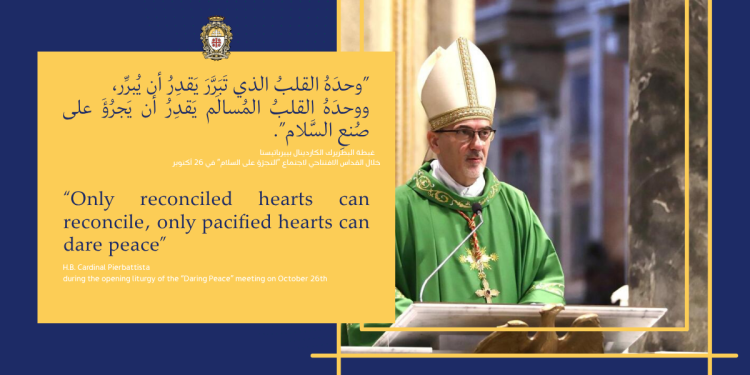
“Only those who recognize their fragility and need for mercy can become instruments of reconciliation…. Only justified hearts can justify. Only pacified hearts can dare to make peace,” said His Beatitude Cardinal Pierbattista Pizzaballa, Latin Patriarch of Jerusalem, in his homily at St. John Lateran in Rome, on October 26th, 2025, as he presided over the Eucharistic Liturgy, which opened the International Meeting organized by Sant’Egidio entitled “Dare Peace”.
The meeting which lasted for three days, brought together Men and Women of different faiths, cultures and socio-political status, all united with a yearn for peace. Thematic round tables and public meetings, focused on current conflicts, and the most urgent challenges facing our world today…at the heart of this meeting was a declaration that peace is worth daring for.
Justice That Comes from Mercy
Reflecting on the Gospel, His Beatitude drew a sharp contrast between the Pharisee and the Tax Collector: one trusts in his own righteousness; the other stands humbly before God, aware of his sin and in need of mercy.
“It is God who justifies, who does justice,” the Patriarch explained. “He does so by forgiving, because only His forgiveness makes us worthy to stand before Him — reestablishing the covenant between men.”
Peace, then, begins not with power or moral superiority, but with truth — the truth of our hearts before God. “Recognizing our weakness allows God to act in us,” he said. “When we recognize our need for mercy, we also allow others to show us mercy. And mercy is the foundation of all justice, on which a solid and true peace can be built.”
The Danger of Self-Righteousness
In contrast, the attitude of the Pharisee reflects what the Patriarch called “the presumption of being right.” This attitude, he warned, can hide not only in individuals but in entire institutions. “How much suffering can be caused,” he lamented, “in the name of one’s own idea of justice, imposed outside a context of respect and listening!”
Such a mindset, he continued, breeds division and violence — the very opposite of peace. “Many today set themselves up as judges, convinced that they are right. But the Gospel reminds us that it is not the force of our judgment that justifies us, but the truth of our hearts before God.”
Mission of the Church
Turning his gaze to the Holy Land, His Beatitude spoke with compassion about the pain that so many are enduring. “No one has the right to minimize this suffering,” he said. Yet he also cautioned against allowing pain to harden hearts or give rise to hatred. “We must not become like the Pharisee who thinks himself better than others.”
The Patriarch emphasized the mission of the Church: “to bring to the world’s attention the lives of those whom many would prefer not to see — those who are real, who exist, and who await our response.”
The Face of Peace
For many who live amid the daily struggle for survival, the word “peace” may sound empty. Yet, His Beatitude reminded the faithful that true peace is not merely the absence of war or the result of diplomacy. “Peace,” he said, begins when we recognize “the truth and dignity of every human being. It is knowing how to see the face of God in others. When the face of the other disappears, the face of God also vanishes — and with it, the possibility of authentic peace.”
Read more: https://www.lpj.org/en/news/what-justice-do-we-seek-what-peace-do-we-desire-a-reflection-from-a
By Miral Atik | LPJ