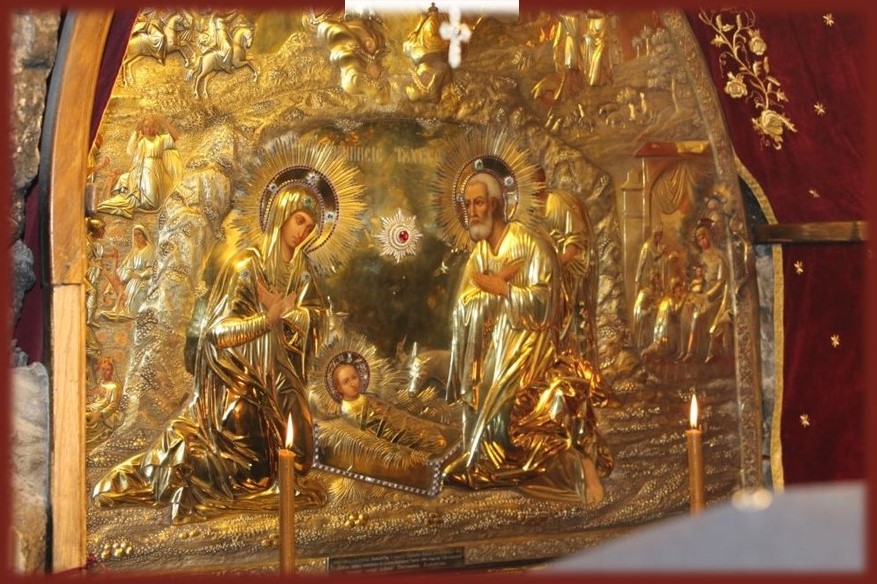
“Heaven and earth are united today,
for Christ is born.
Today God hath come upon the earth,
and man hath ascended into the heavens.”
(Troparion of the Entreaty of the Feast of the Nativity)
“With ineffable and complete joy, in doxology and thanksgiving, the Church today mystically lives, proclaims to her members, and heralds to the entire world the mystery revealing God’s ineffable love for mankind, wrought through the Incarnation of His Only-begotten Son and Word, our Lord Jesus Christ by the Holy Spirit and the Virgin Mary.”
This mystery is beyond all human understanding. In relation to it, the Church — as the guardian of God’s Divine Providence for the salvation of humanity — preserves and passes down to us what she has received from the beginning in the Holy Scriptures, guarding it as the very apple of her eye: the prophetic word, “Behold, a Virgin shall conceive and bear a son” — “Unto us a Child is born, unto us a Son is given” (Isa. 7:14; 9:6); the apostolic word, “When the fullness of time had come, God sent His Son, born of a woman, born under the law” (Gal. 4:4); the evangelic word, “The Word became flesh and dwelt among us” (John 1:14); the angelic hymn from heaven, “Glory to God in the highest, and on earth peace, good will toward men” (Luke 2:14); and the hymn’s call, “Christ is born; glorify Him. Christ comes from heaven; go forth to meet Him. Christ is on earth; be exalted.”
The Fathers also bear witness. Saint Athanasius declares: “The incorporeal, incorruptible, and immaterial Word of God enters our world… condescending for our sake through His love for mankind and His manifestation” (MPG 25, 109A). Saint Gregory the Theologian proclaims: “He who was without flesh is made flesh; the Word is revealed; the Invisible is seen… the Timeless has a beginning; the Son of God becomes the Son of man” (MPG 36, 313B), and again: “Today we celebrate the visitation of God to men, that we may dwell with God” (MPG 36, 316A). Saint Cyril of Alexandria adds: “These things are done for the good of humanity: God is united with human nature so that humanity may be perfected through participation in the exaltation of God” (MPG 76, 1132).
In Christ, God assumes human nature in hypostatic union — the whole person. “You have taken me wholly unto Yourself, wholly in flawless union,” sings the hymnographer, and again: “Remaining God in essence, He assumed the form of man without change.” He took on flesh animated by a rational soul and revealed Himself to humanity “in one hypostasis and two natures.” God and man together — the God-Man — united without confusion. Eternally in the bosom of the Father, He also became “contained within a mother’s womb,” according to Saint Sophronius of Jerusalem (MPG 87, 3, 3161A), entering a virginal womb and “coming forth from her with the assumption.”
This transcendent mystery of the conception of the Word of God by the Holy Spirit and the Virgin Mary was fulfilled when the bodiless Archangel Gabriel, “having received in knowledge the command given in secret, hastened to Joseph’s dwelling,” and appeared in Nazareth; it became even clearer when the Incarnate One “was born in secret in the cave” in holy Bethlehem, in the days of Caesar Octavian Augustus. Then “the days were completed for her to give birth, and she brought forth her firstborn Son, wrapped Him in swaddling clothes, and laid Him in a manger” (Luke 2:6–7).
Then the Magi, kings from Persia — the first fruits of the Church among the Gentiles — were guided by a star from heaven, that is, by the Holy Spirit, according to Saint John Chrysostom: “which came and stood over where the Child was” (Matt. 2:9). They came and worshipped the newborn King of peace, “for they saw in the cave the Infant who is without beginning.” Witnesses of this divine vision were also the shepherds in the fields near Bethlehem, informed by an angel who proclaimed: “Today a Saviour is born to you, who is Christ the Lord, in the city of David” (Luke 2:11).
In the Incarnation, the Lord made the human nature He assumed His own — inseparably united with Him. Born in the flesh, circumcised, “growing in wisdom and stature, and in favor with God and man” (Luke 2:52), baptised in the Jordan by John and attested in a Trinitarian manner, He called the Twelve, “whom He also named apostles” (Luke 6:13). He lived among men and taught them; healed incurable infirmities; raised the dead; poured out His redeeming blood on the Cross; rose from the dead; and ascended into heaven “with that which He had assumed,” that is, humanity, glorifying and deifying it, “honouring it with a seat at the right hand of the Father.”
Such grace, deification, and glory were also granted to “all the children in Bethlehem, from two years old and under” (Matt. 2:16), victims of Herod’s madness — the first martyrs for Christ’s name.
Having sent from heaven, from the Father, “another Comforter,” His Holy Spirit, upon His holy disciples and apostles, the Lord “brought the whole world into their care.” He entrusted to the apostles and their successors — the Church — His holy work. This work, the Church continues sacrificially through the ages, rejecting all violence and carrying out pastoral, philanthropic, humanitarian, and pacifying ministry. Like the Good Samaritan, she anoints the wounds of humanity with the oil of consolation.
This work is also faithfully carried out by the Church of the Holy Places and Most Holy Shrines, the Mother of all Churches, throughout the Holy Land. Above all, she preserves the God-receiving Grotto and the surrounding Constantinian and Justinian Basilica; a construction that is the adornment, pride, and support of Bethlehem’s Christians and the long-suffering Palestinian people. From this sacred place, on this very night of the Metropolis of Feasts, she lifts up prayers for peace and good order throughout the world and the Middle East; for the implementation of the ceasefire in Gaza; and for the protection of those who have taken refuge in the holy Monastery of Saint Porphyrios. She prays for her flock and for all the faithful pilgrims celebrating the Feast of the Nativity, that the grace and strength of Jesus Christ the King, born in the flesh, may remain with them throughout the Twelve Days, filling their hearts with peace, joy, gladness, and righteousness. Amen. So be it.
Many happy returns — blessed and sanctifying Christmas!
In the Holy City of Bethlehem, Christmas 2025
THEOPHILOS III
Patriarch of Jerusalem
By jerusalem-patriarchate.info