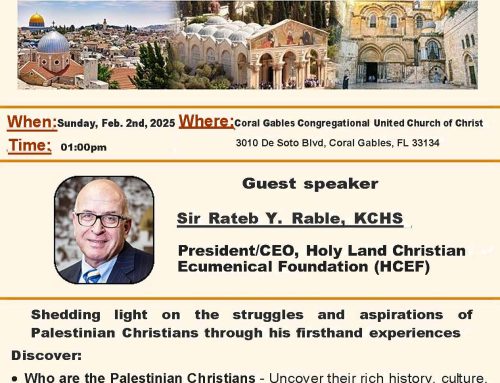
Washington, DC — On Thursday, July 24, 2025, the Holy Land Christian Ecumenical Foundation (HCEF) hosted a meeting with representatives of the United States Conference of Catholic Bishops (USCCB) and Palestinians and Arab American leaders to address the July 17 Israeli military strike on the Holy Family Church in Gaza—the only Latin (Catholic) church in the Strip.
The strike, carried out by an Israeli tank shell, tragically killed three civilians and left four others seriously wounded, including two in critical condition. The church’s pastor, Fr. Gabriel Romanelli, also sustained minor injuries and continues to receive care. Once a sanctuary for civilians seeking safety, the Holy Family Church has now become a symbol of escalating violence and disregard for sacred spaces.
The meeting was requested by HCEF to raise serious concerns over the USCCB’s public response, which, while offering prayers and calling for a ceasefire, did not explicitly name the Israeli military as the perpetrator, leading to public confusion and diminished moral clarity.
Participants
Representing the USCCB:
- Bishop A. Elias Zaidan, Chairman, Committee on International Justice and Peace
- Sir. Christopher Ljungquist, Director, Office of International Justice and Peace
Representing HCEF and Palestinian and Arab Americans Leaders
- Sir Rateb Rabie, KCH, President and CEO, HCEF
- Dr. Hanna Hanania, HCEF Board Member
- George Salem, Esq., American federation of Ramallah, Palestine
- Khalil Jahshan, Executive Director, Arab Center Washington DC
- Dr. James Zogby, President, Arab American Institute
Key Issues Raised
HCEF and its partners expressed appreciation for the USCCB’s concern for the victims but urged the bishops to:
- Explicitly condemn the Israeli military for the July 17 attack on the Holy Family Church
- Clarify the source of the strike to avoid misleading public interpretations
- Advocate for:
a) An immediate and sustained ceasefire
b) The resumption of food and humanitarian aid to prevent famine in Gaza
c) A re-examination of the Catholic Edition of “Translate Hate”, a joint document between the USCCB and AJC, which contains inaccuracies that harm Arab Christian voices and misrepresent the Palestinian narrative.
USCCB Response
Bishop Zaidan responded with empathy and understanding, noting his personal familiarity with the region, as a native of Lebanon and frequent pilgrim to the Holy Land, most recently in January 2025. He acknowledged the suffering of the Palestinian people and expressed openness to future collaboration.
Mr. Ljungquist shared that the USCCB has implemented new internal procedures to assess the policy impact of its statements and ensure clearer and more informed communication going forward.
Next Steps
The meeting concluded with a mutual commitment to continued dialogue and cooperation. Bishop Zaidan expressed interest in including Palestinian Christian perspectives in future USCCB communications and advocacy efforts, and in holding regular follow-up discussions.
As a next step, HCEF has formed a dedicated Advocacy Committee to:
- Monitor developments on the ground
- Coordinate with Church leaders, human rights organizations, and international partners
- Mobilize public support across Christian communities
A Constructive First Step
HCEF commends the USCCB for its willingness to listen, engage, and improve. This meeting marks an important and constructive first step toward stronger collaboration in defense of justice, truth, and the protection of innocent lives in the Holy Land.
“There are approximately 77 million Catholics in the United States. This makes Catholicism the largest single religious denomination in the country, accounting for about 23.2% of the total U.S. population.”