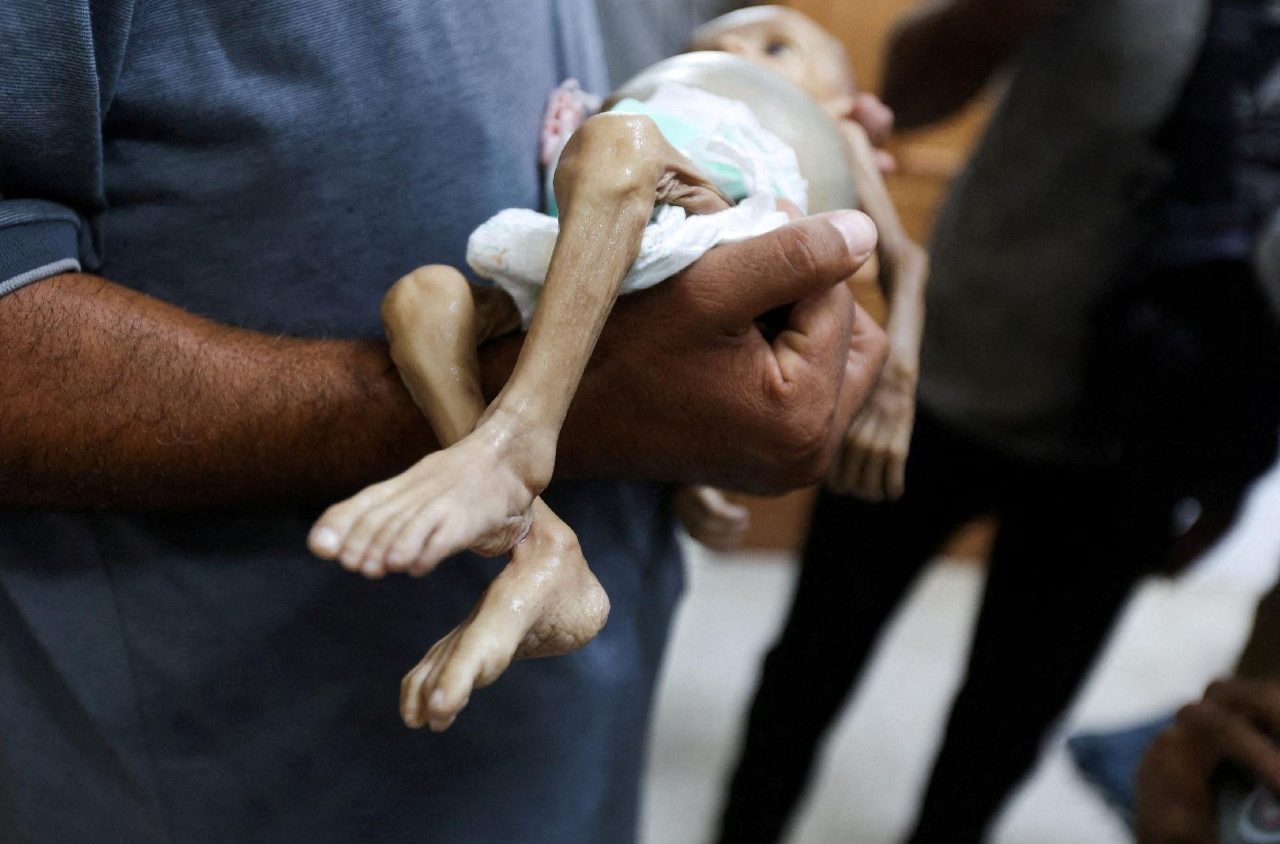
The latest information from the United Nations shows that more than one third of the residents of Gaza are going without food for days, and more than half a million people are enduring famine-like conditions. All others are facing emergency levels of hunger. The UN agencies providing emergency food aid, helping babies and children with nutrition and medicine have appealed to the international community to act immediately as famine conditions spread. They say without an immediate full-scale humanitarian response, thousands will die very soon, since less than five percent of what is needed to prevent mass starvation is being allowed to enter Gaza.
The Director-General of the Food and Agriculture Organization, QU Dongyu, has warned that, “Gaza is now on the brink of a full-scale famine. People are starving not because food is unavailable, but because access is blocked, local agrifood systems have collapsed, and families can no longer sustain even the most basic livelihoods.” He has appealed for “safe and sustained humanitarian access and immediate support to restore local food production and livelihoods,” the only way to prevent further deaths. “The right to food is a basic human right.”
Focusing on the human rights questions regarding Palestine is Australian lawyer Chris Sidoti, who is a commissioner of the UN Independent International Commission of Inquiry on the Occupied Palestinian Territory, including East Jerusalem and Israel. In an interview with Vatican News / Vatican Radio, he appealed for full-scale emergency food aid to be allowed in immediately, as time is running out very quickly to save thousands from dying. This action is essential in the short term, he underscores, while a durable ceasefire is also needed to stop the killing. He also looks at the long-term prospects for a two-state solution that would allow a Palestinian state and Israel to live side by side in peace and security.
Vatican Radio interview with Chris Sidoti, a commissioner with the UN Independent International Commission of Inquiry on the Occupied Palestinian Territory, including East Jerusalem and Israel.
Q: About the humanitarian situation in Gaza, there’s been a bit of a change with some airdrops, a little more aid being allowed in. But overall, how do you see the situation there? How would you describe it?
‘A little more aid getting in’ is an accurate description. It is a very small amount at this stage. Airdrops are good, but no substitute in terms of quantity for the provision of aid by trucks. We have to get trucks into Gaza if we are to relieve the desperate situation there. Before this war, before October 2023, there were up to 2,000 trucks a day going into Gaza, and that was still under a situation of very tight Israeli control of the kinds of goods that were able to enter.
After October 2023, the supplies were curtailed dramatically. And even during the brief ceasefire this year, from January into late March, there were only 600 trucks a day going into Gaza. Now, the UN agencies and international non-government organisations estimate that at least 2,000 trucks a day are required simply to maintain a very basic level of food supply. Now, during that period that that ceasefire period, it was 600 trucks a day. (On 28 July), under the loosened conditions that the Israeli Prime Minister proclaimed, 90 trucks went in. So that’s less than a sixth of the number that went in during the ceasefire, and less than 5% of the number that is required to simply sustain the basic quantity of food and water for the people of Gaza. So it’s clearly totally inadequate. It is literally a sop to opinion coming from countries all over the world that are saying that this Israeli imposed mass starvation is a most serious war crime.
Do you think, finally, countries speaking up that there’s a positive effect this can have and that’s led to what is this slight improvement?
Certainly this speaking up has led to this very slight improvement, but that’s not adequate. As I say this, this is a sop to international pressure. What is really required is not speaking up, but serious action. Action that will place real pressure on the Israeli government and not simply the pressure of words. So, there is certainly a requirement, a desperate need, but also a legal obligation on other states to do everything in their power, short of invading Gaza, to force the Israeli government to allow adequate food supplies to enter Gaza. There are thousands of trucks, in fact, outside the borders of Gaza, waiting to enter if the Israeli authorities will let them in. They need to be allowed in. It’s as simple as that.
What else needs to happen? Obviously, we’re at a critical point from the humanitarian point of view because the time is really running out. But what else needs to happen here, would you say, for the situation to improve even a little bit?
Well, the most important thing that needs to happen is adequate quantities of food and water and medical supplies need to be allowed in. Now that is desperate. Some of the UN agencies are saying that the red line has already been crossed, that retrieving the situation without thousands or even tens of thousands of people dying is already too late. I hope that’s not the case. I’m not an expert on humanitarian assistance and what people need to eat and how much is required. But I hope against hope, that it is not too late to stop mass starvation in Gaza. But that’s the first and most immediate need food, water, and proper medical supplies and fuel to enable hospitals to operate. Power to be provided so that incubators for babies can work, oxygen can be provided, and so forth. The Israeli authorities are showing no sign whatsoever of permitting this. The concession that was given yesterday (27 July), and that has started to be implemented today (28 July), is very, very small and far from adequate to ensure that starvation is adequately addressed. So that’s what needs to happen immediately.
Read more: https://www.vaticannews.va/en/world/news/2025-07/un-human-rights-lawyer-appeals-humanitarian-action-save-gaza.html
By Thaddeus Jones | vaticannews